Electronic records with context intact

A result is only as strong as the record behind it.

Obsidian Metra keeps calibration work connected to the asset, controlled method, technical evidence, reviewer and history that give it meaning.

A deliberate record lifecycle

From first entry to frozen evidence

The record develops with the work. Context and revision identity travel forward, reducing the need to reconstruct a calibration months or years later.

  1. 01

    Create in context

    Record work against the organisation, asset, requirement and applicable controlled procedure.

  2. 02

    Review the evidence

    Keep measurements, reference standards, uncertainty and conformity reasoning together for review.

  3. 03

    Freeze the outcome

    Approved and submitted records retain the evidence and controlled revisions used at that point in time.

  4. 04

    Correct with history

    Use revision and supersession paths instead of silently replacing the original regulated record.

  5. 05

    Prepare the proof

    Create a frozen dossier snapshot from the records already captured during normal work.

Capture work where it happens

More than a result entered afterwards

A calibration event can retain the performed date, outcome, procedure execution, certificate evidence and technical records that support review. Each part has its own purpose without losing its relationship to the whole.

  • Controlled procedure steps and responses
  • Reference standards actually used
  • Measurement and certificate evidence
  • Review and approval lifecycle
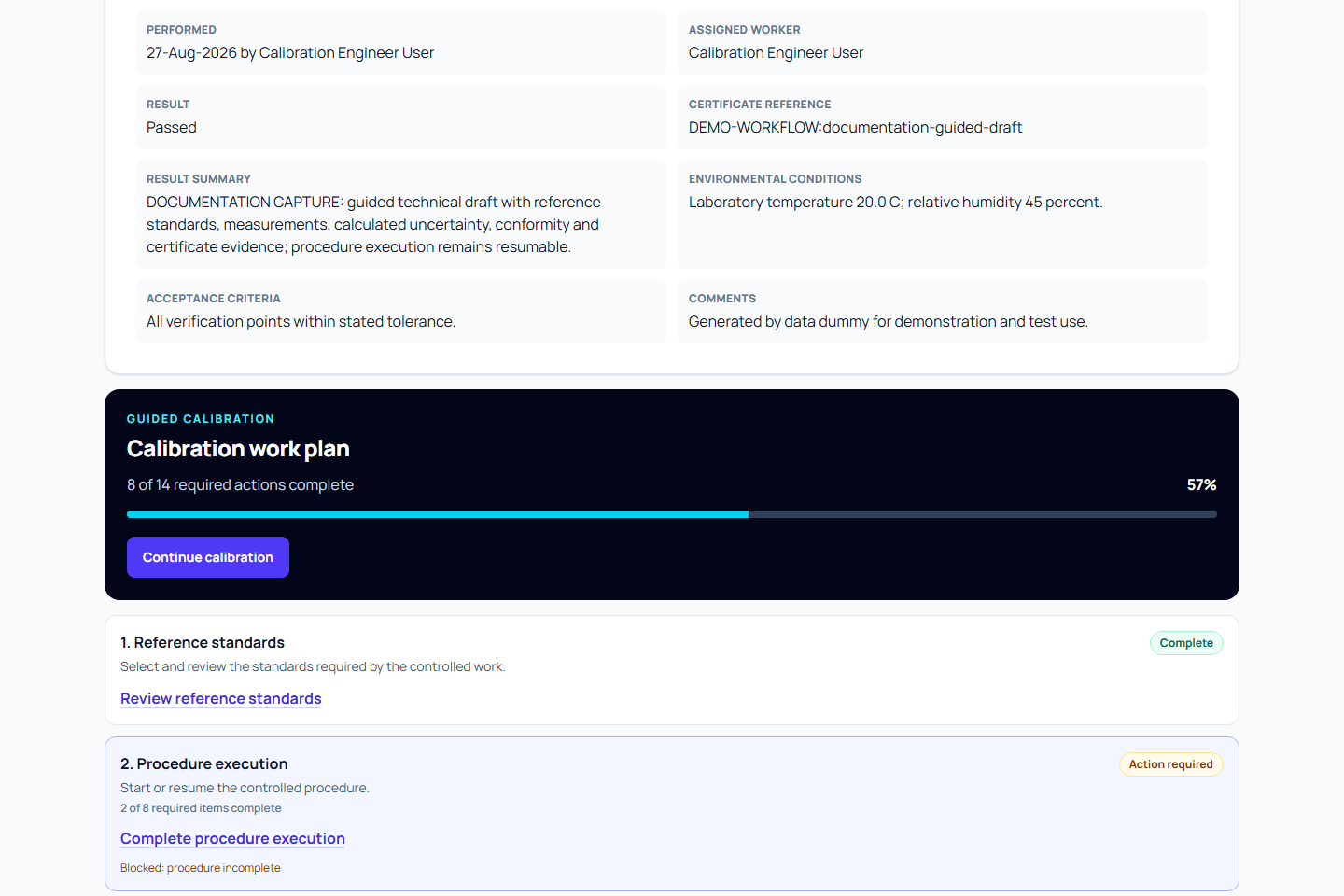
Read-only calibration hub showing guided progress, evidence status and submission readiness
The read-only hub keeps context and readiness visible while focused pages handle each evidence task.

The reasoning travels with the outcome

Freeze the evidence, not just the word "pass"

Approved work retains the controlled procedure revision and the applicable uncertainty and conformity evidence. Later changes to those controlled models do not silently rewrite the historical basis of the result.

A future recalculation can use a new revision while the approved historical record continues to show the evidence used originally.
Frozen conformity evidence showing the measured value, uncertainty, acceptance limits and controlled decision result
A readable decision record preserves the inputs, rule and result together.

Readable first. Verifiable underneath.

Evidence with layers of context

Users see the asset and work they recognise. Detailed identifiers and system provenance remain available when deeper verification is required.

Operational identity

Asset ID, deployment history and requirement context make the record recognisable to the people doing the work.

Technical evidence

Measurements, reference standards, uncertainty and decision rules explain how the result was reached.

Lifecycle evidence

Status transitions, review, approval, correction and investigation preserve what happened after capture.

System provenance

Record identifiers, timestamps, actors, revisions and checksums support detailed verification when needed.

Controls throughout the system

Designed for records that need to stand up to review

Record integrity is built from multiple explicit controls rather than a single claim or exported document.

Organisation boundary
Records are scoped to an organisation, with backend membership and permission checks controlling access.
Purpose-built records
Equipment, requirements, calibration events, certificates and investigations remain distinct, connected domain records.
Time and actor context
UTC timestamps and authenticated membership context help show when activity occurred and who performed it.
Preserved revisions
Controlled procedures, uncertainty budgets and decision rules retain revision identity when used in approved work.
Certificate history
External evidence and generated certificates retain versions, supersession or void relationships, frozen signatures, sequential identity and cryptographic checksums.
Audit history
Significant workflow activity contributes to a traceable audit record rather than relying on the final PDF alone.
Frozen technical evidence
Approved results preserve the relevant reference usage, uncertainty calculation and conformity decision evidence.
Controlled retrieval
Evidence and generated dossier files are retrieved through authenticated application workflows.
A snapshot for the audit room

Turn connected records into a reviewable dossier

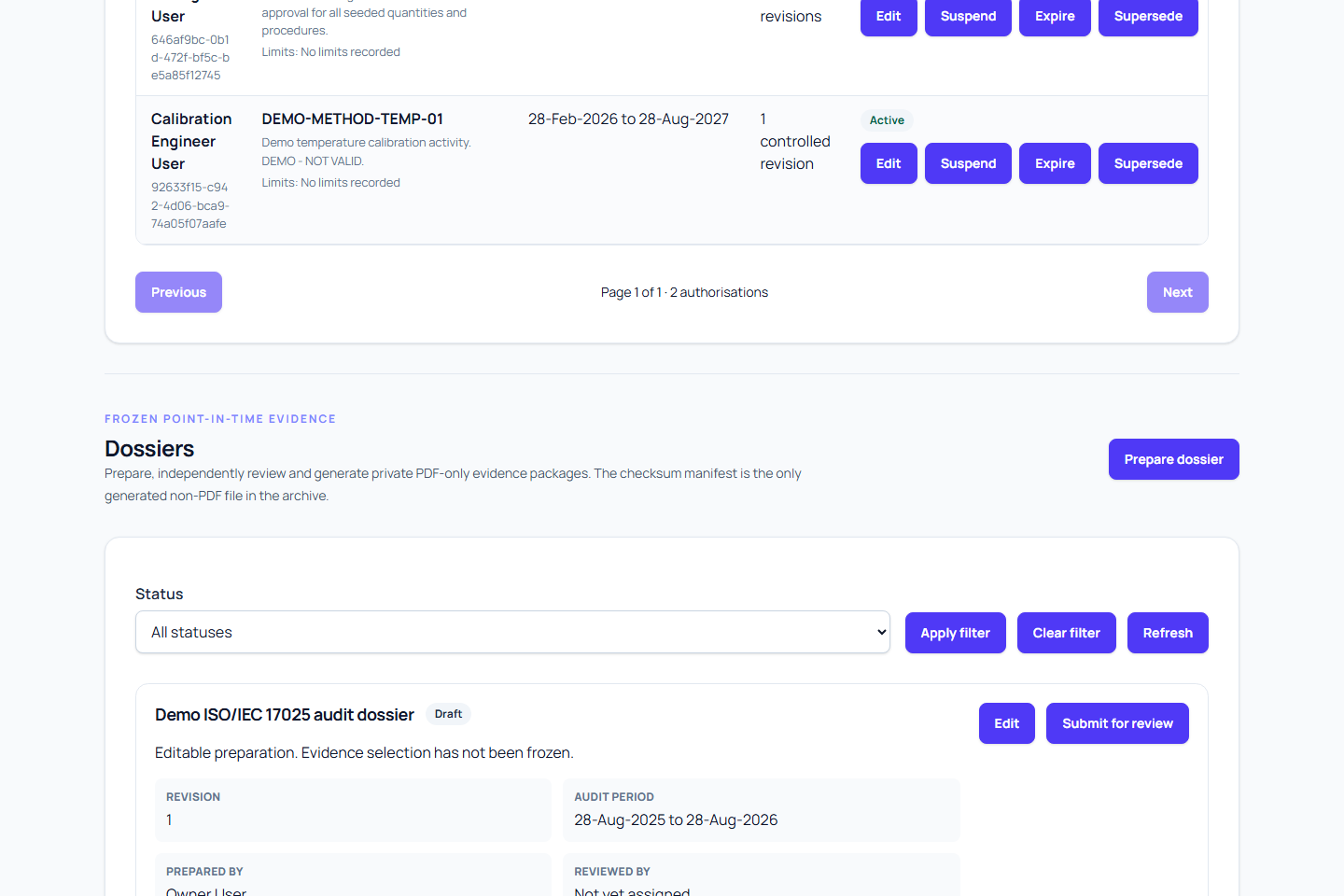
Choose the relevant client or internal sites and reporting period. Metra freezes the submitted scope and assembles the related assets, calibration work, certificates, traceability and audit evidence.

See how audit readiness works
ISO audit dossier workspace showing frozen site scope, reporting period and evidence selection
Dossier revisions preserve their submitted scope and evidence selection.

Important responsibility

Technology supports the control environment

Obsidian Metra does not by itself establish regulatory compliance, legal admissibility or the suitability of an electronic record for a particular intended use. Customers remain responsible for system validation, operating procedures, access governance, training, retention decisions and assessment against the regulations and quality standards that apply to them.

Keep the evidence connected from day one

Build a record your team can understand later.

Explore the guides, review the security approach, or create an account and start with your first controlled equipment record.