Calibration operations, connected

From instrument bench to audit room.

Obsidian Metra turns calibration work into a connected evidence trail, without making technicians fight the software to record it.

A complete working path

Five steps. One continuous evidence trail.

Each stage carries context forward, so the result is connected to the asset, procedure, references and controlled calculations behind it.

  1. 01

    Register

    Create a clear equipment record, then assign it through a time-bounded deployment.

  2. 02

    Plan

    Set recurring requirements and see what is current, due soon or overdue.

  3. 03

    Perform

    Guide technicians through controlled procedures and capture evidence as work happens.

  4. 04

    Review

    Apply uncertainty budgets and decision rules before independent approval.

  5. 05

    Prove

    Prepare traceable evidence packs and ISO/IEC 17025 audit dossiers.

See the work before it becomes a problem

A calibration plan people can act on

The dashboard turns recurring requirements into a clear queue of current, due-soon, due and overdue work. Teams can move from the organisation view to the exact equipment record without losing context.

  • Multiple calibration requirements per asset
  • Client, site and location history derived from deployments
  • Deployment history for equipment that moves between facilities
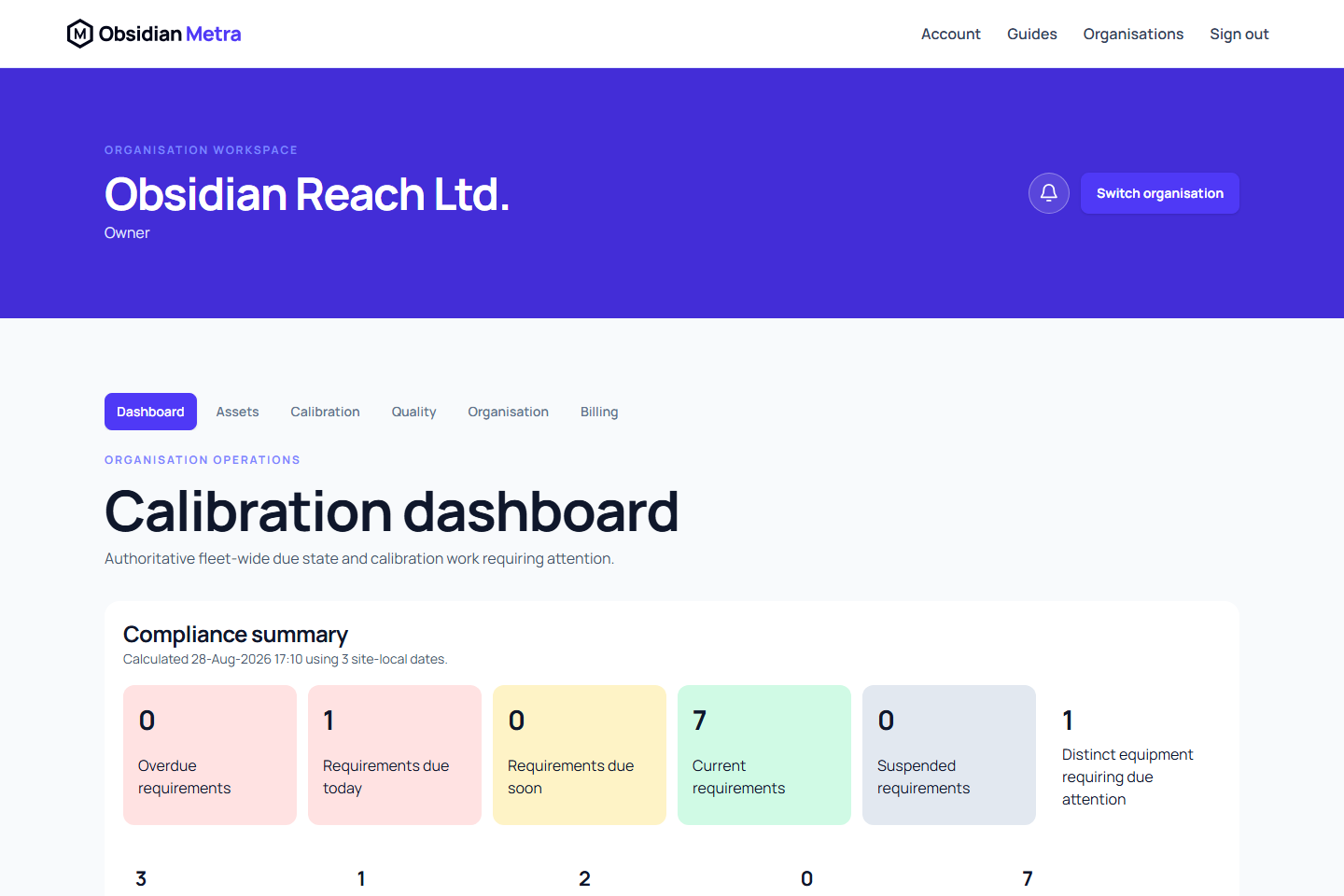
Calibration dashboard showing status totals, filters and scheduled calibration work
The dashboard gives teams an immediate, filterable view of upcoming work.

Work from an approved method

Procedures that guide, not just describe

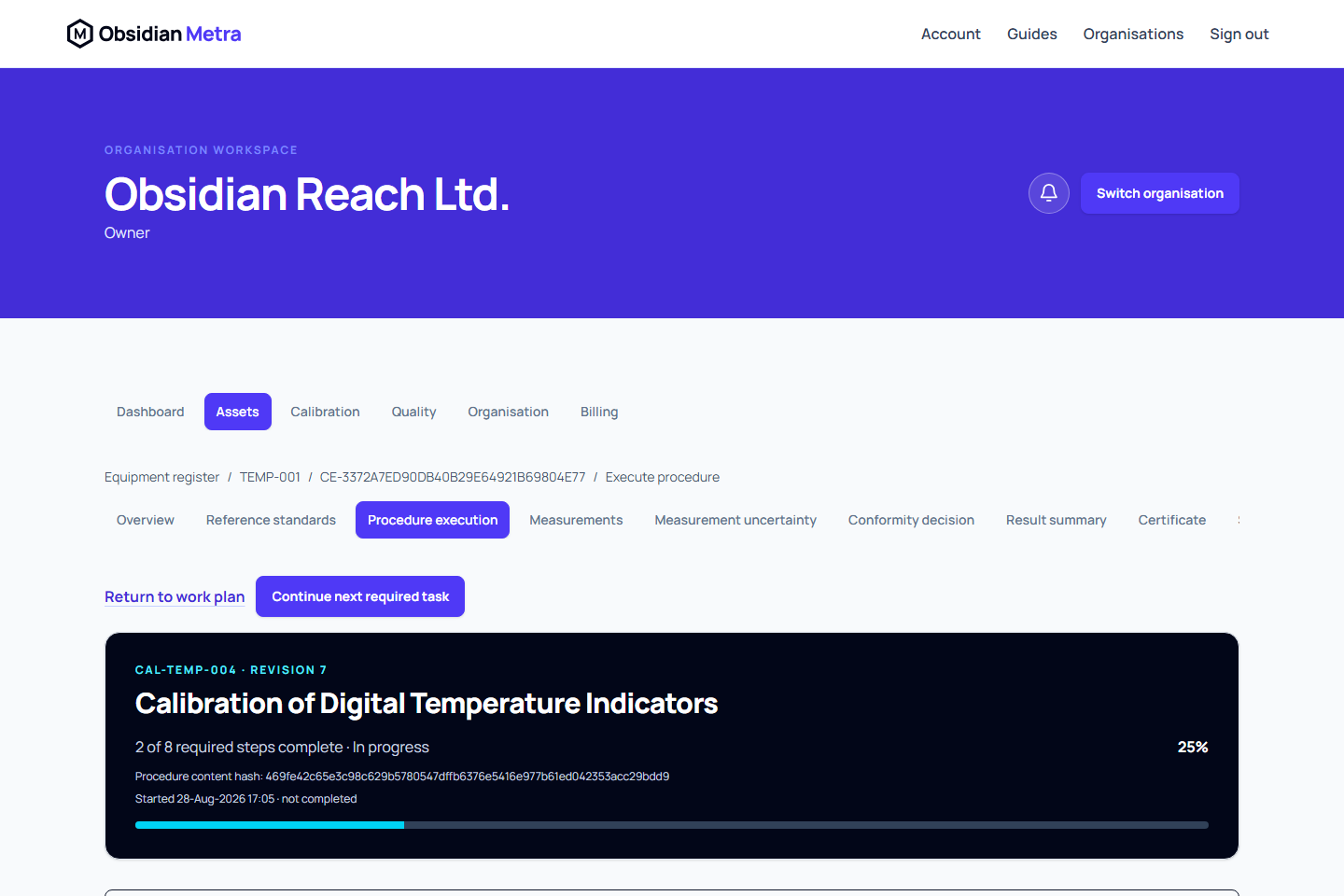
Author controlled procedures with stable step keys, ordered instructions and evidence needs. During calibration, technicians work through the applicable revision and build a complete execution record as they go.

Approved calibration evidence retains the procedure revision and responses used at the time. Later procedure changes do not rewrite historical work.
Resumable calibration procedure showing saved steps and the next unresolved task
Technicians capture the work against a controlled procedure instead of reconstructing it later.

Traceability with structure

Know which reference made the result possible

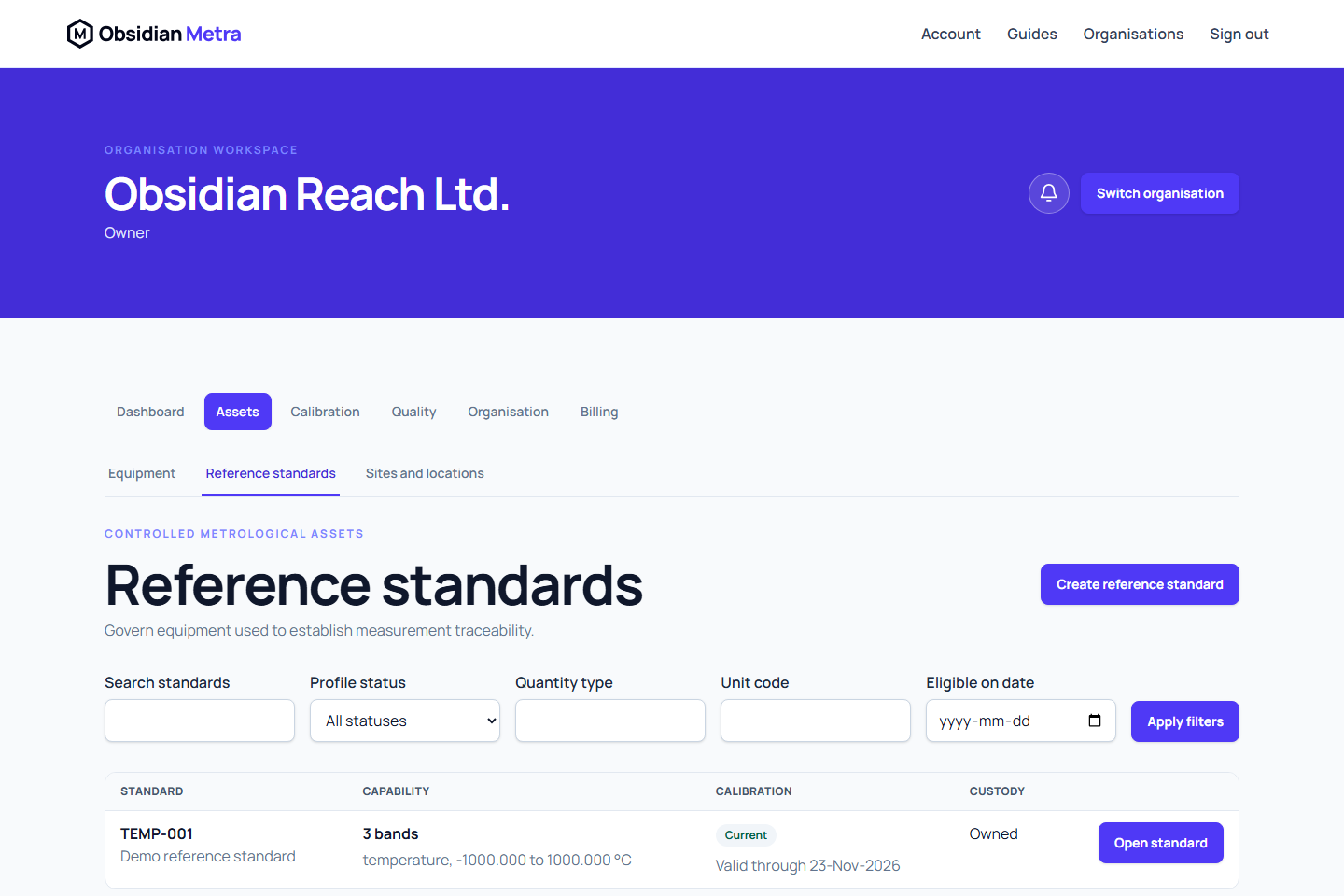
Reference standards are first-class equipment records with calibration status, capability ranges, uncertainty, restrictions, accreditation information and certificates. Metra records the standards actually used for each calibration.

  • Eligibility checked against the date of work
  • Warnings and acknowledgements retained with the evidence
  • Traceability-chain completeness made visible to reviewers
Reference standards register showing controlled metrological assets and calibration status
Reference capabilities and calibration state stay connected to the asset that provides them.

Make the calculation explain itself

Uncertainty and conformity, connected

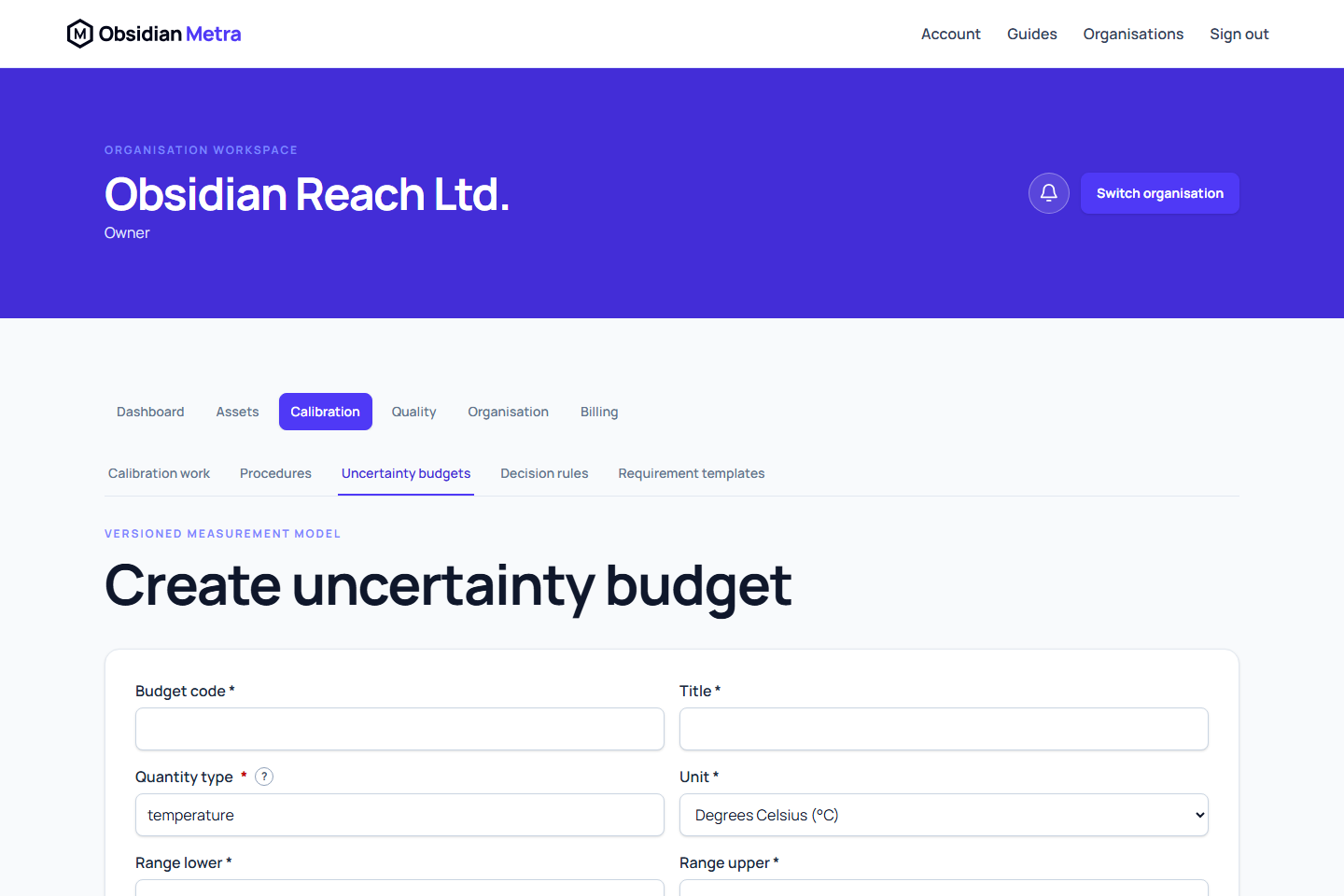
Build versioned uncertainty budgets from Type A and Type B components, then calculate combined and expanded uncertainty at the calibration point. Controlled decision rules apply tolerances, guard bands and boundary policies to explain why a result passed or failed.

Calculation
Versioned
Approved result
Frozen
Versioned uncertainty budget authoring with controlled components and coverage factor
A readable calculation record links inputs to the reported uncertainty.
Conformity decision evidence showing tolerance, measurement error, guard band and result
The decision record preserves the rule and calculated limits behind the outcome.

When a result needs action

Keep exceptions attached to the evidence

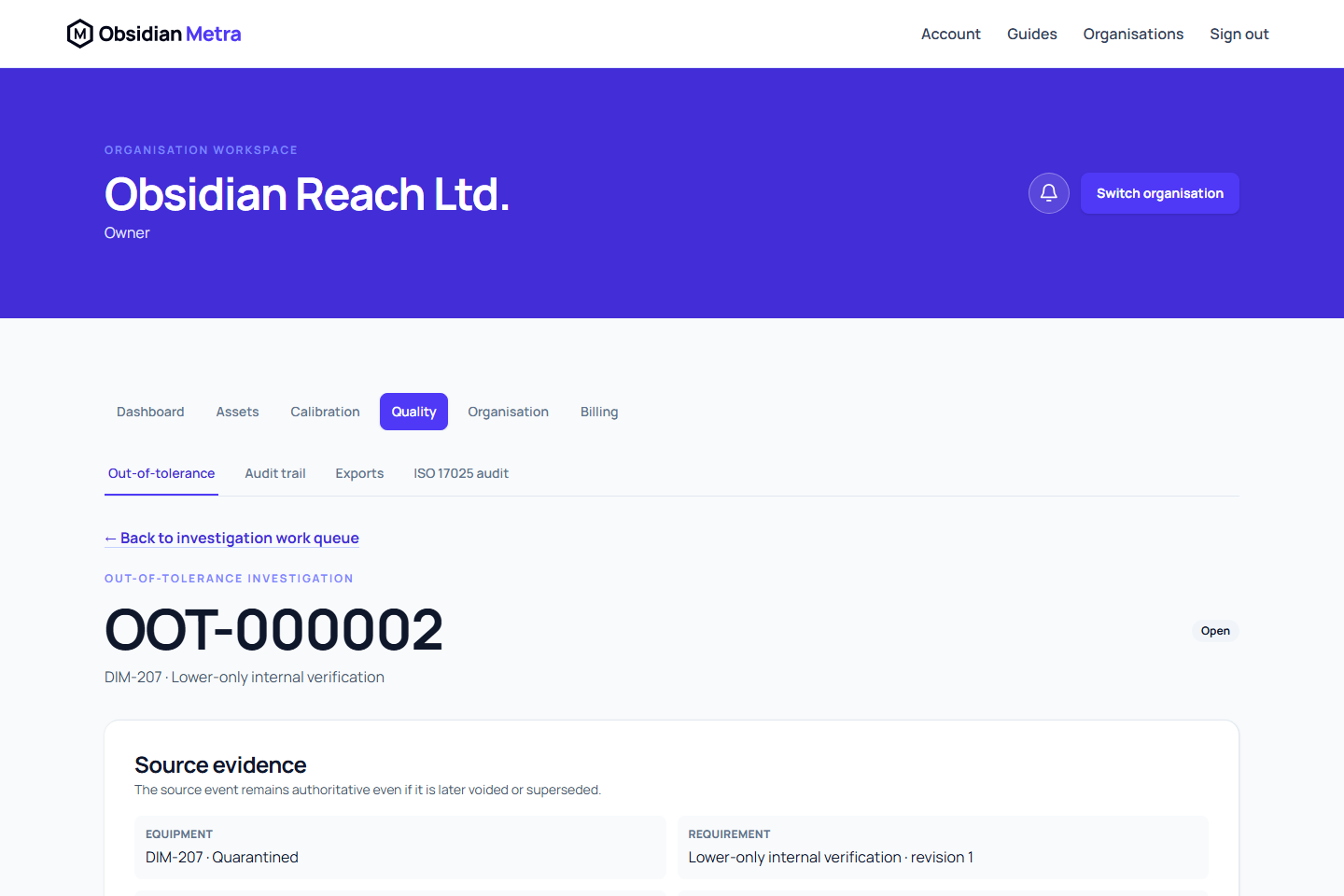
A failed or unacceptable calibration can open an out-of-tolerance investigation. Capture impact, containment, root cause, disposition and corrective action without separating the quality record from the calibration that triggered it.

Out-of-tolerance investigation workspace showing impact assessment and corrective actions
Investigation activity remains part of the traceable quality history.

Audit-ready by design

Build the dossier from the records you already keep

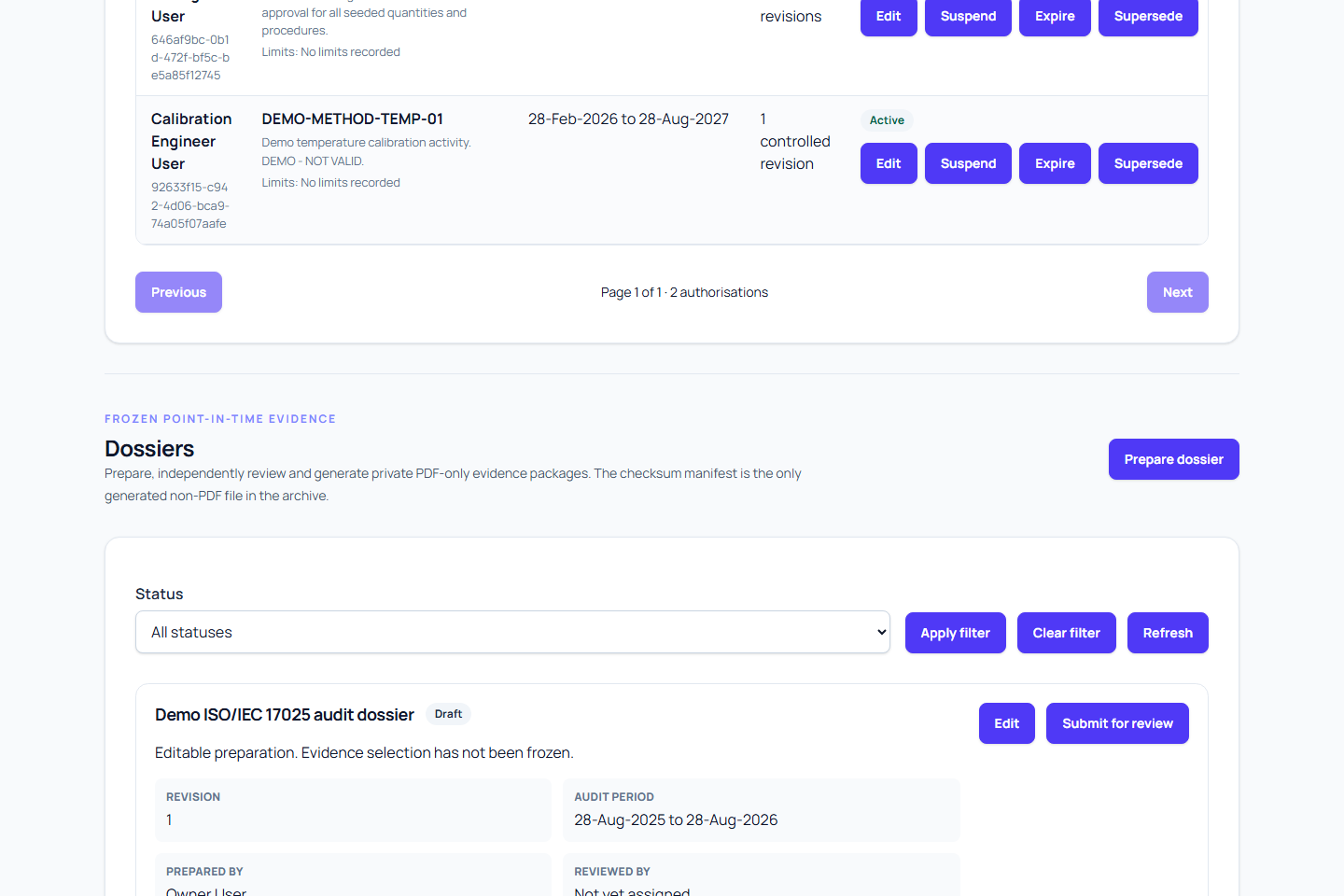
Select a client, internal or client-backed sites, and a period. Metra freezes the dossier scope and assembles relevant equipment, calibration work, certificates, traceability, personnel, controlled documents and audit history.

Metra supports ISO/IEC 17025 evidence management; it does not itself confer accreditation or guarantee compliance.

ISO audit dossier workspace with site scope, date range and evidence selection
Dossier preparation brings operational and technical evidence into one reviewable package.

Built into the workflow

The controls you need, without a maze of disconnected tools

Every capability contributes to the same organisation-scoped history and permission model.

Equipment control
Deployment-based placement history, movement and sensor rotation
Calibration planning
Multiple requirements, due status and responsible people
Controlled work
Read-only work hubs, focused evidence pages, resumable procedures and frozen execution evidence
Metrological traceability
Reference standards, capability ranges, certificates and usage
Measurement confidence
Versioned uncertainty budgets and per-point calculations
Defensible conformity
Controlled decision rules, guard bands and frozen outcomes
Controlled certificates
Readiness checks, sequential numbering, electronic signatures, accreditation scope, immutable revisions and public verification
Quality follow-through
Out-of-tolerance investigations and corrective actions
Audit evidence
Equipment evidence packs, audit trails and dossier generation

See the detail. Keep the simplicity.

Put calibration evidence to work from day one.

Explore the step-by-step guides, compare subscription options, or create an account and start with your first equipment record.