For calibration and testing laboratories

Run the method.
Retain the reasoning.

Bring controlled procedures, traceability chains, technical calculations and approvals into one connected record, from work at the bench to evidence in the audit room.

Supports evidence management within your quality system. Does not confer accreditation.

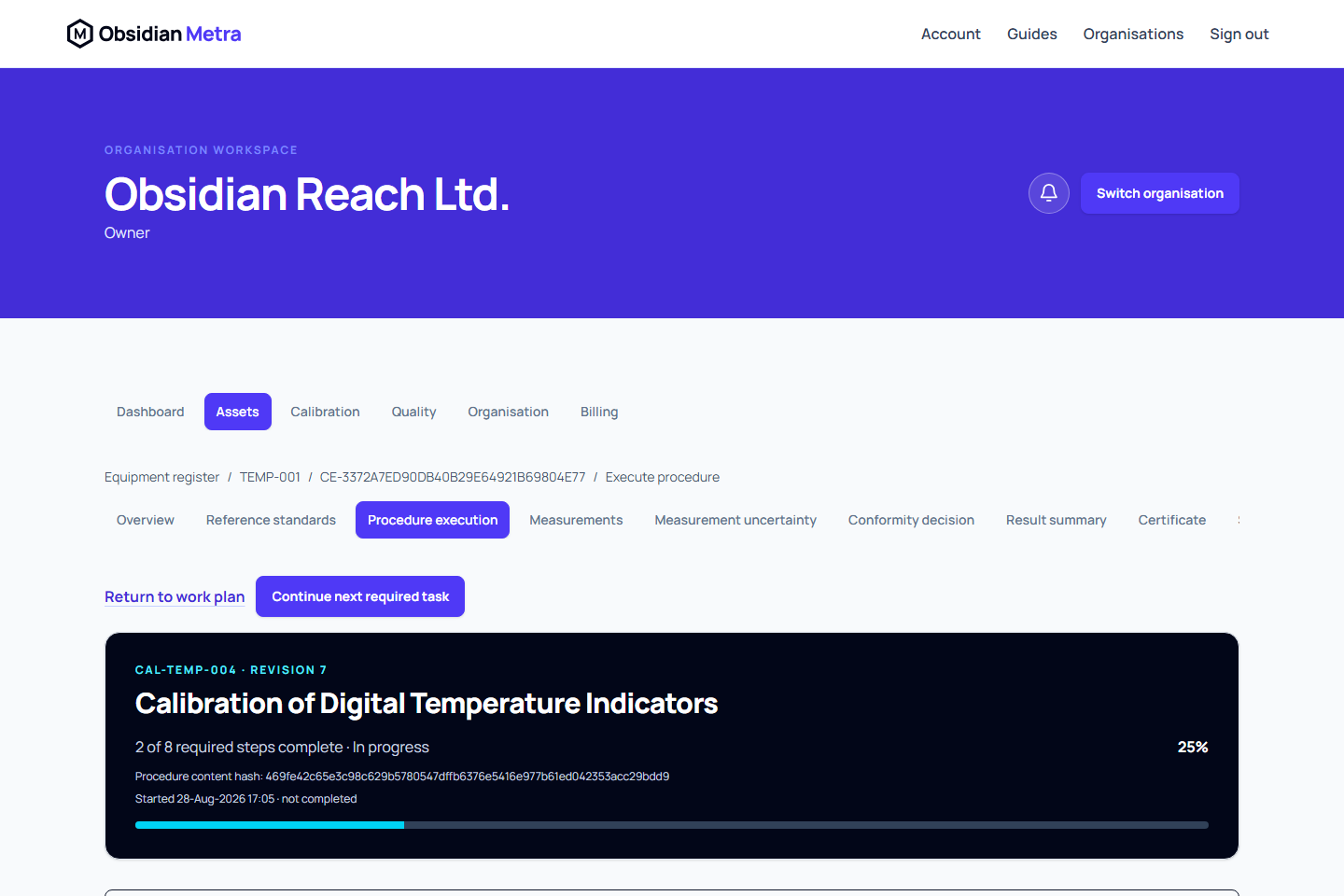
Obsidian Metra showing a controlled calibration procedure with ordered steps and recorded evidence

A controlled bench workflow

Evidence captured while the work is still in view

  1. 01

    Prepare

    Confirm the equipment, applicable method revision and eligible reference standards.

  2. 02

    Perform

    Follow ordered procedure steps and capture readings, conditions and supporting evidence.

  3. 03

    Evaluate

    Apply the approved uncertainty budget and decision rule to the recorded result.

  4. 04

    Approve

    Route the complete technical record to authorised reviewers before release.

Method control at the point of work

Give technicians the procedure that actually applies

Start with procedure identity, scope and readable ordered steps. Add advanced evidence, uncertainty and conformity controls only where the step requires them, then complete a pre-review check before independent approval.

  • Progressive authoring with a clear pre-review checklist
  • Ordered execution steps with required evidence
  • Historical results protected from later method changes
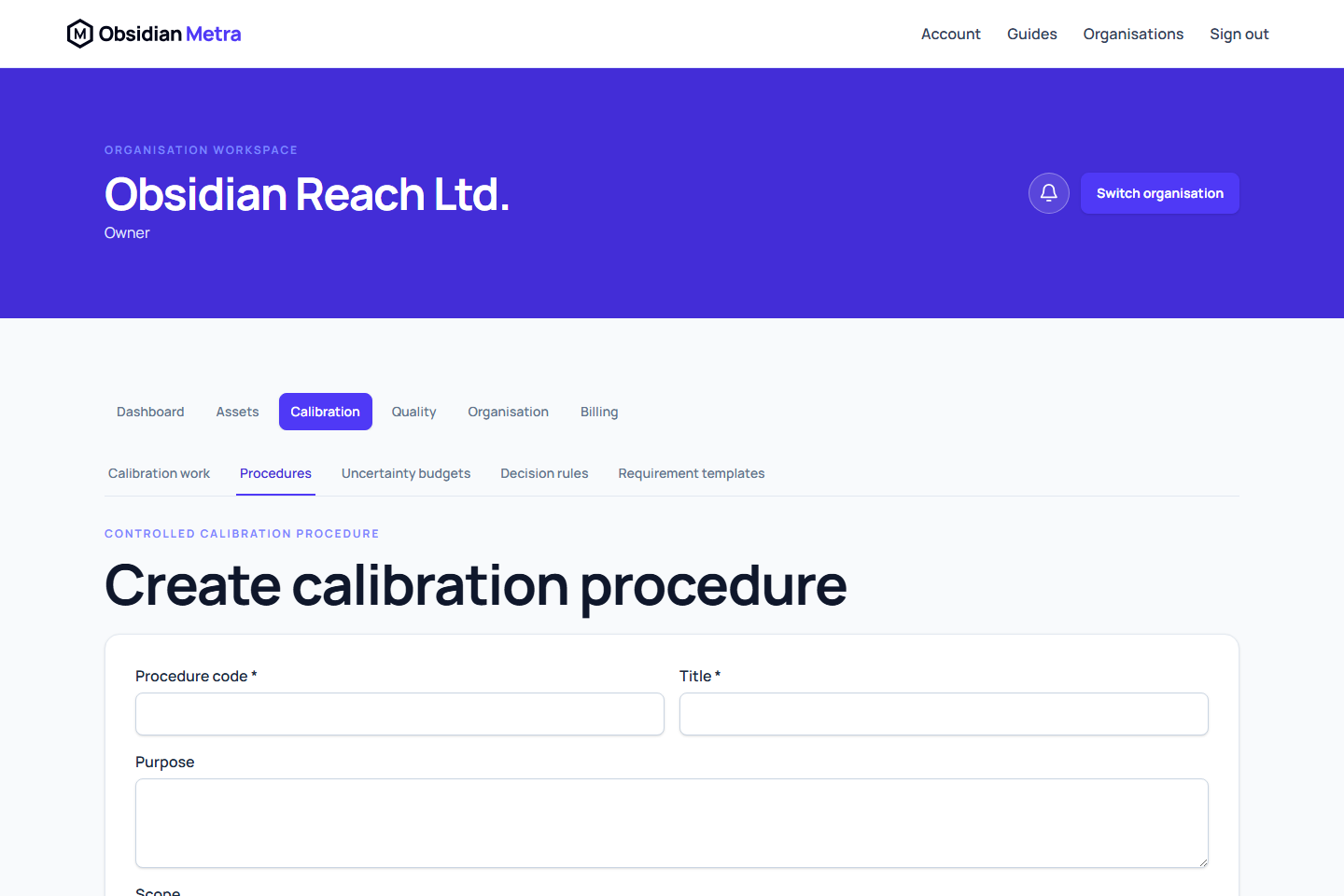
Calibration procedure authoring workspace showing a controlled method and ordered steps
Author the readable method first, then add only the controls each step needs.

Traceability with operating context

See the chain behind each measurement

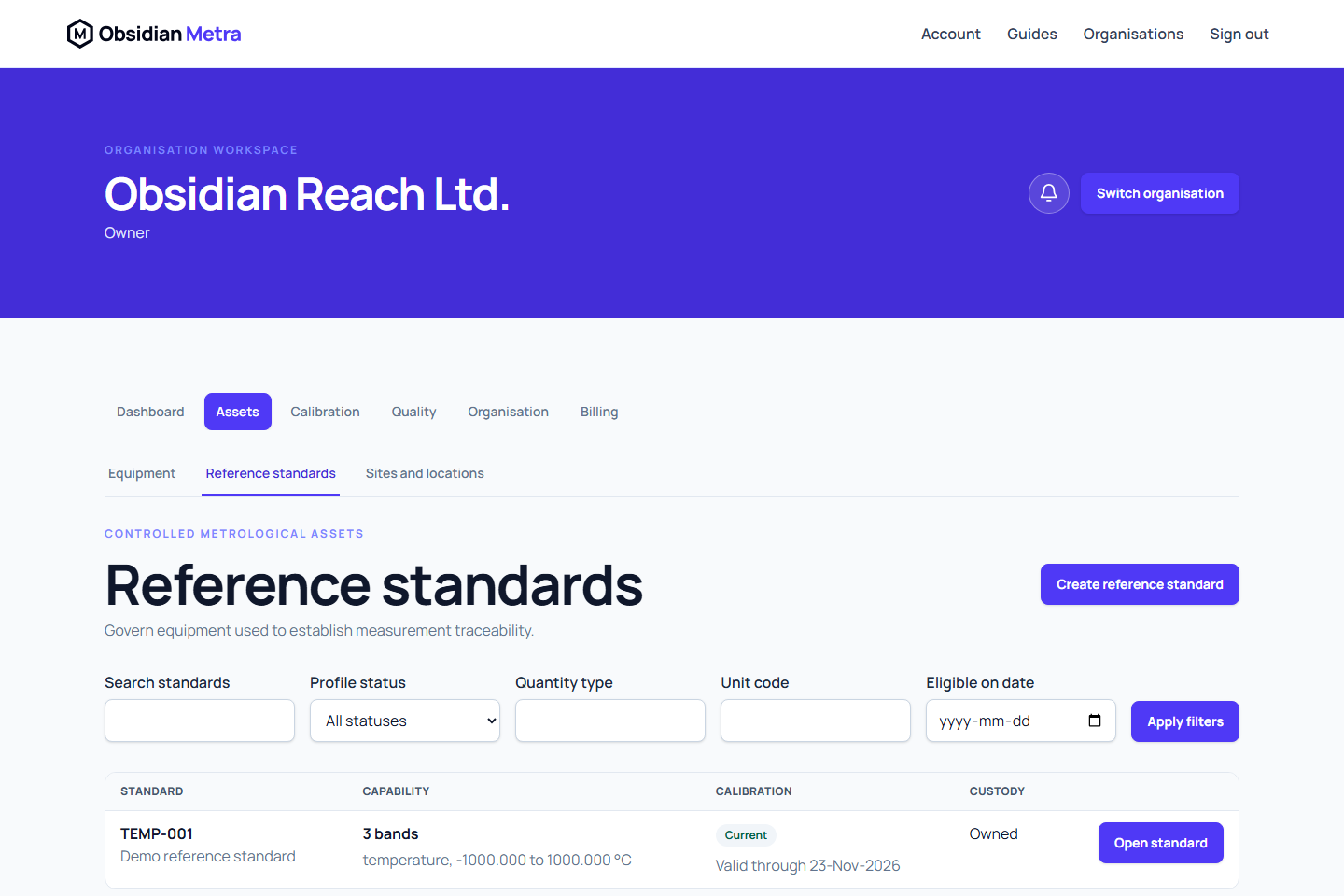
Treat reference standards as controlled assets with capability, range, calibration status, certificate evidence and restrictions. Record which standard was actually used so reviewers can follow the traceability chain from result to reference.

Eligibility findings and acknowledged restrictions stay visible beside the event instead of disappearing into a separate spreadsheet.
Reference standards register showing controlled assets, capability ranges and calibration status
Reference identity, capability and calibration state stay together.

Technical reasoning, versioned

Keep the calculation with the conclusion

Preserve the controlled inputs used to evaluate a result, not only the final pass or fail.

CONTROLLED MEASUREMENT MODEL

Versioned uncertainty budgets

Build reusable budgets from Type A and Type B components, distributions, divisors, sensitivity coefficients and coverage factors. Approved evidence retains the budget revision and per-point calculation used at the time.

Measurement uncertainty evidence showing controlled components and expanded uncertainty
Inputs, calculation and expanded uncertainty remain reviewable as one record.

CONTROLLED CONFORMITY MODEL

Decision rules that remain explainable

Connect measured error, tolerance, uncertainty, guard band and boundary policy to the conformity outcome. Reviewers can see which approved rule was applied rather than infer it later.

Review before release

Approvals with the full technical record in view

Support separation of duties and scoped personnel authorisations without disconnecting approval from the evidence being reviewed.

01 / PERFORM

Capture the work

Technicians complete the method and submit its connected evidence.

02 / REVIEW

Assess the record

Authorised reviewers inspect results, references and calculations together.

03 / APPROVE

Preserve the outcome

Approval freezes relevant revisions and records the decision history.

Organisation and site isolation

One system, clear operating boundaries

Keep organisation-owned records within their authorised organisation context. Within it, site and location relationships provide the operating context for equipment, standards, work and evidence.

Roles and permissions are resolved for the selected organisation, helping multi-site teams collaborate without treating frontend filters as a security boundary.

Northstar LaboratoriesAUTHORISED ORGANISATION

Dimensional laboratory

Equipment · standards · procedures · evidence

Temperature laboratory

Equipment · standards · procedures · evidence

Site-scoped operational context

One connected laboratory record

Control the work. Keep the context.

Controlled procedures
Author, approve and issue methods as distinct revisions, then retain the exact revision used for each calibration event.
Reference standards
Connect standards, capability ranges, calibration state, certificates and restrictions to the work where they were used.
Uncertainty budgets
Version Type A and Type B components, distributions, sensitivity coefficients and coverage factors without rewriting history.
Decision rules
Keep tolerance, uncertainty, guard band and boundary policy beside the resulting conformity statement.
Technical approvals
Separate performance from review and preserve who approved the evidence, when, and against which controlled revisions.
Audit dossiers
Freeze selected sites, reporting periods and evidence into reviewable dossier revisions while leaving source records intact.

Audit evidence without reconstruction

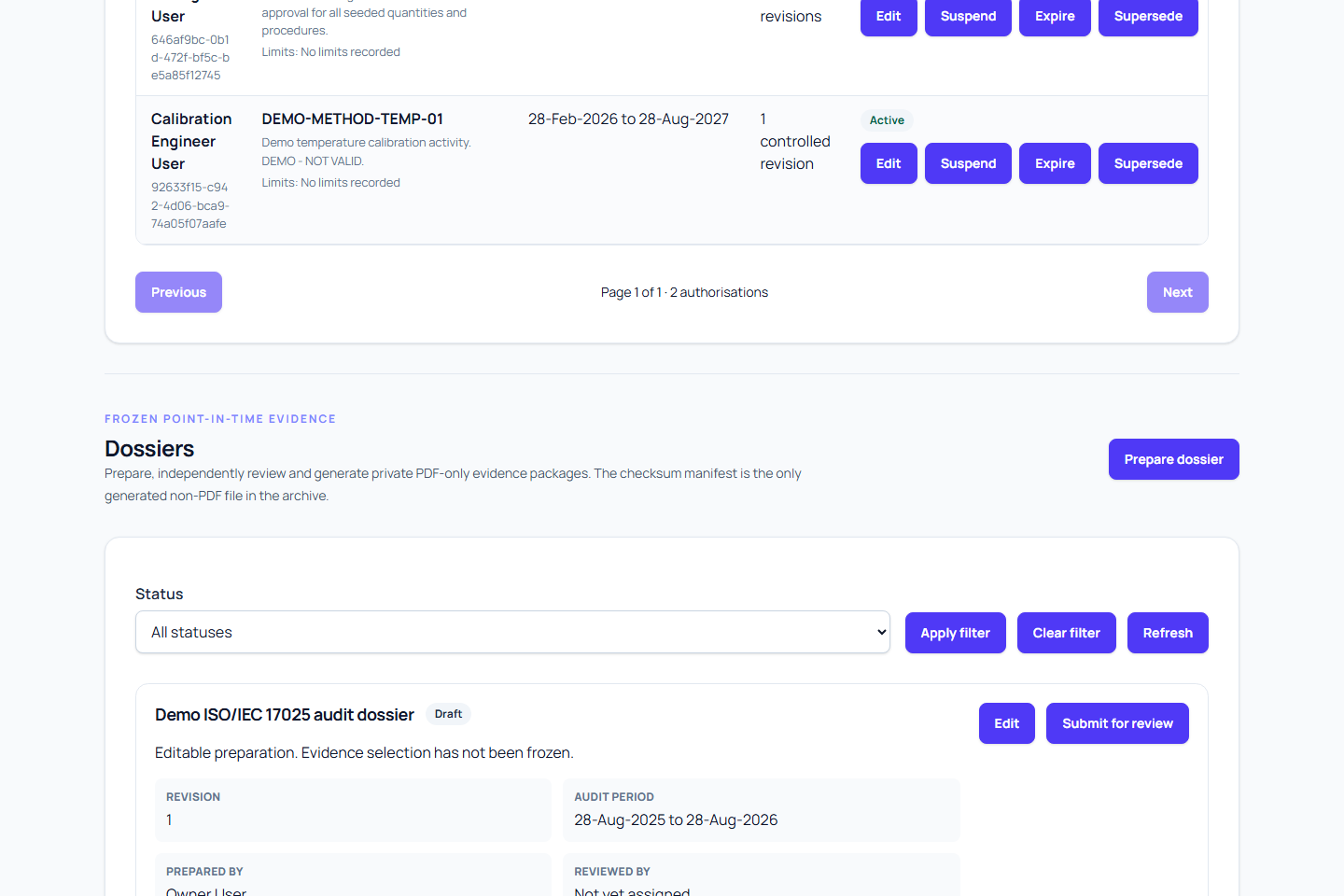
Prepare a scoped, reviewable dossier

Select internal or client sites and a reporting period, review the included evidence, then preserve that scope in a dossier revision without altering the underlying records.

  • Equipment identity and deployment context
  • Procedure revisions and execution evidence
  • Reference standards and traceability chains
  • Uncertainty and conformity evidence
  • Approvals, certificates and audit history
Audit dossier workspace showing selected sites, reporting period and evidence scope
Dossier scope and evidence remain visible before a revision is submitted.

Software support, not accreditation

Your laboratory retains professional responsibility

Obsidian Metra supports controlled workflows and the management of ISO/IEC 17025-related evidence. It does not confer accreditation, certify conformity, guarantee compliance, or replace professional judgement. Your laboratory remains responsible for its methods, competence, decisions and quality system.

Explore evidence support

Build the record as the work happens

Give every result a defensible path.

Start with an instrument, define its controlled work, and keep the evidence connected through technical approval and audit preparation.