Review and approve a calibration procedure
Only approved, currently effective revisions on an active procedure can be assigned to new requirements and calibration work.
Submit a review-ready revision
- Open the procedure and inspect its code, revision, purpose, scope and change summary.
- Review every ordered step, required response and permitted not-applicable choice.
- Confirm measurement points, units, reference-standard needs and evidence requirements are appropriate.
- Resolve every blocking item in the Pre-review checklist.
- Save the draft and select Submit for review.
Complete the independent hand-off
After submission, the workspace shows Awaiting independent review. It explains who can act and why the current user may be unable to approve:
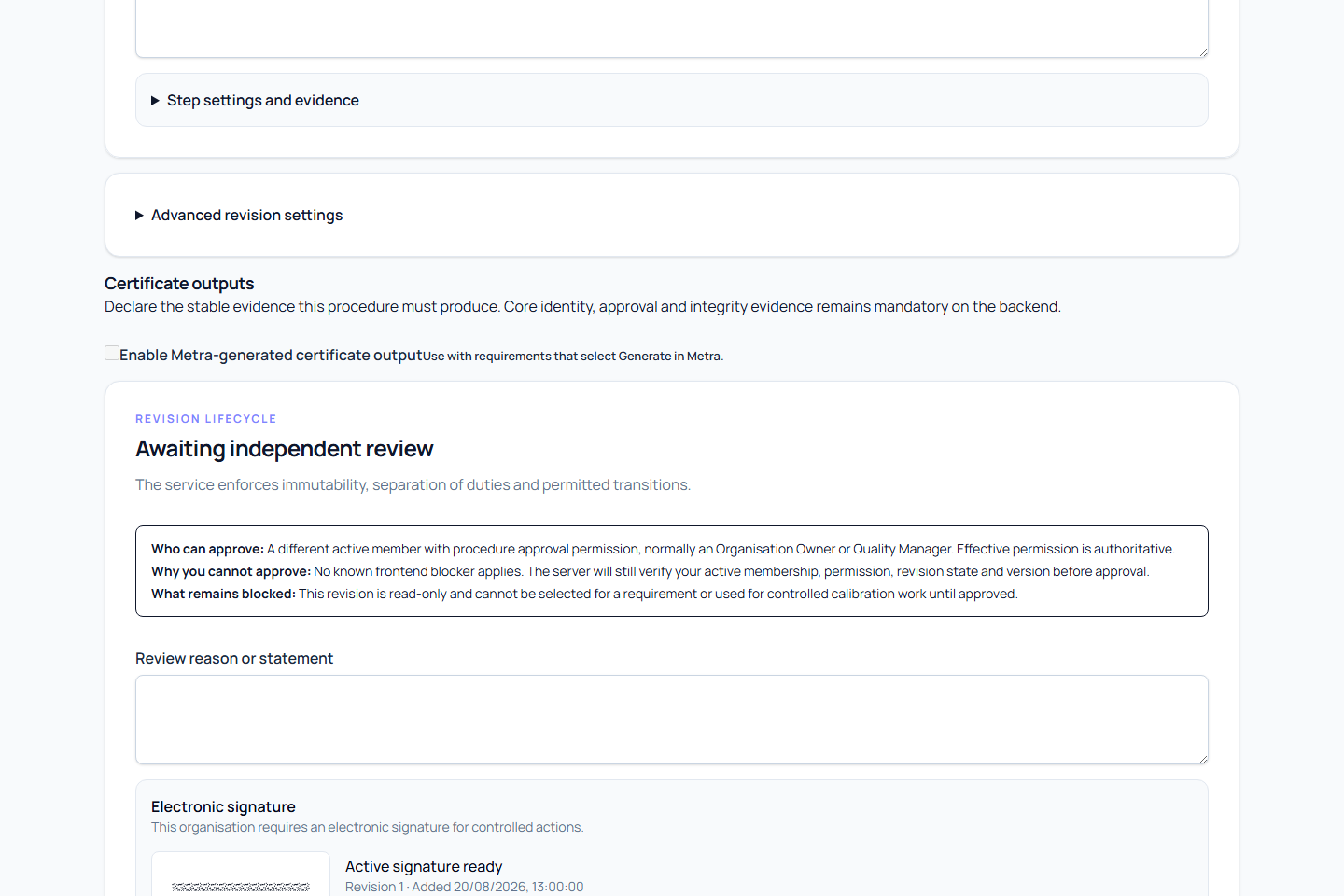
- Procedure approval requires an active member with
calibration-procedure:approve; Organisation Owners and Quality Managers normally hold it. - The revision author cannot approve their own revision, even when their role otherwise permits approval.
- A member without the effective approval permission cannot approve or reject it.
- A revision outside
in_reviewcannot receive an approval decision.
While review is pending, the revision cannot be edited, assigned to a new requirement, or used to start new calibration work. The reviewer either approves it or rejects it with a reason so the author can correct a new draft revision.
The author cannot approve their own revision. An approved revision is fixed and has a content hash. Rejection and withdrawal retain history and require a reason.
Use the approved revision
When the revision is approved, active, effective, and unexpired, select Use this revision in a requirement. Choose the equipment and create or update its requirement with the recognizable procedure code and revision.
A future-effective revision remains unavailable until its effective date. An expired revision or a revision on a non-active procedure cannot be newly assigned. Approval never silently moves existing requirements to the new revision; update each affected requirement deliberately after impact review.