Author and approve a decision rule
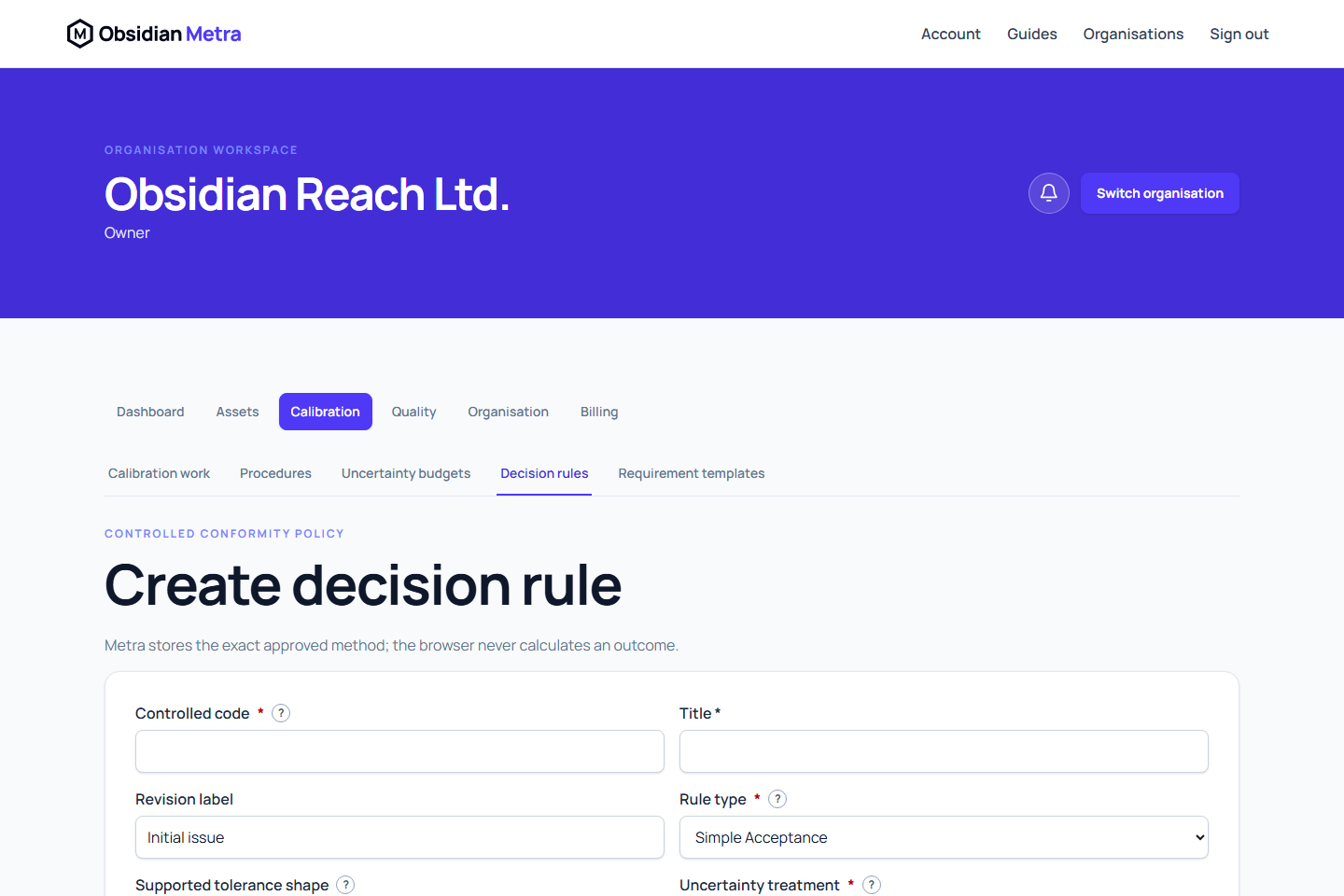
- Open Calibration and then Decision rules.
- Select Create decision rule.
- Enter a unique controlled code, title, purpose, and intended use.
- Choose simple acceptance, fixed absolute guard band, or uncertainty-multiplier guard band.
- Select the supported tolerance shape: any, two-sided, upper-only, or lower-only.
- State whether uncertainty is not used, combined standard uncertainty, or expanded uncertainty.
- Make lower and upper boundary inclusion explicit.
- Record supported outcomes, reporting language, restrictions, and source references.
- Create the draft, review it, and make any required draft edits.
- Submit the draft for review.
- Have a different authorised member approve it.
Draft revisions can be edited using their current version. After a revision has been submitted or approved, use Create new revision to create a superseding draft rather than changing the controlled record. The current lifecycle exposes submit and approve actions; it does not expose reject, withdraw, retire, or archive actions.
Submitted and approved revisions are fixed. The author or submitter cannot approve the same revision. Approving a newer revision supersedes the previous approved revision without changing calibration work already pinned to it.
An approved revision contains a content hash. Calibration work pins that exact revision, not whichever revision is newest later.
Next: Assign a decision rule.